
Documentation changed in 2026. It used to have one audience: the humans on your team. Now it has two. AI coding agents read your docs to understand your codebase, and they fail badly when those docs are missing, stale, or invisible to them.
That shift split the tooling market into three camps:
- Doc-site builders , polished sites you write yourself, with AI helping the prose.
- Code-to-docs generators , tools that read your source and produce the docs for you.
- Agent-context layers , docs exposed so AI agents can actually read them.
The right tool depends on which problem you have. Here's an honest comparison of the leading options, what each is genuinely best at, and where each one stops.
Quick comparison
| Tool | Best for | Generates from your code | Updates as code changes | Readable by AI agents | Pricing |
|---|---|---|---|---|---|
| Code Summary | Docs generated from your code, kept current, for humans and agents | Yes | Yes, on push | Yes, live MCP endpoint | Free to start; $19 to $899/mo + Enterprise |
| Mintlify | Polished docs you author | No (you write, AI assists) | AI suggestions | Limited | Free tier; paid + Enterprise |
| DeepWiki | Understanding any repo fast | Yes (read-only wiki) | On demand | Limited | Free for public repos; paid for private |
| Swimm | Keeping hand-written docs in sync | Partial | Flags stale on change | No | Free tier; per-seat |
| DocuWriter | A generated doc tree from source | Yes | Manual or scheduled | No | Paid (trial) |
| GitBook / ReadMe | Knowledge bases and API reference | No | No | Limited | Free tier; paid |
| CodeGPT / Copilot | In-editor explanations | No (inline) | No | No | Low per-seat |
The tools, honestly
Code Summary , generated from your code, kept current, for both audiences
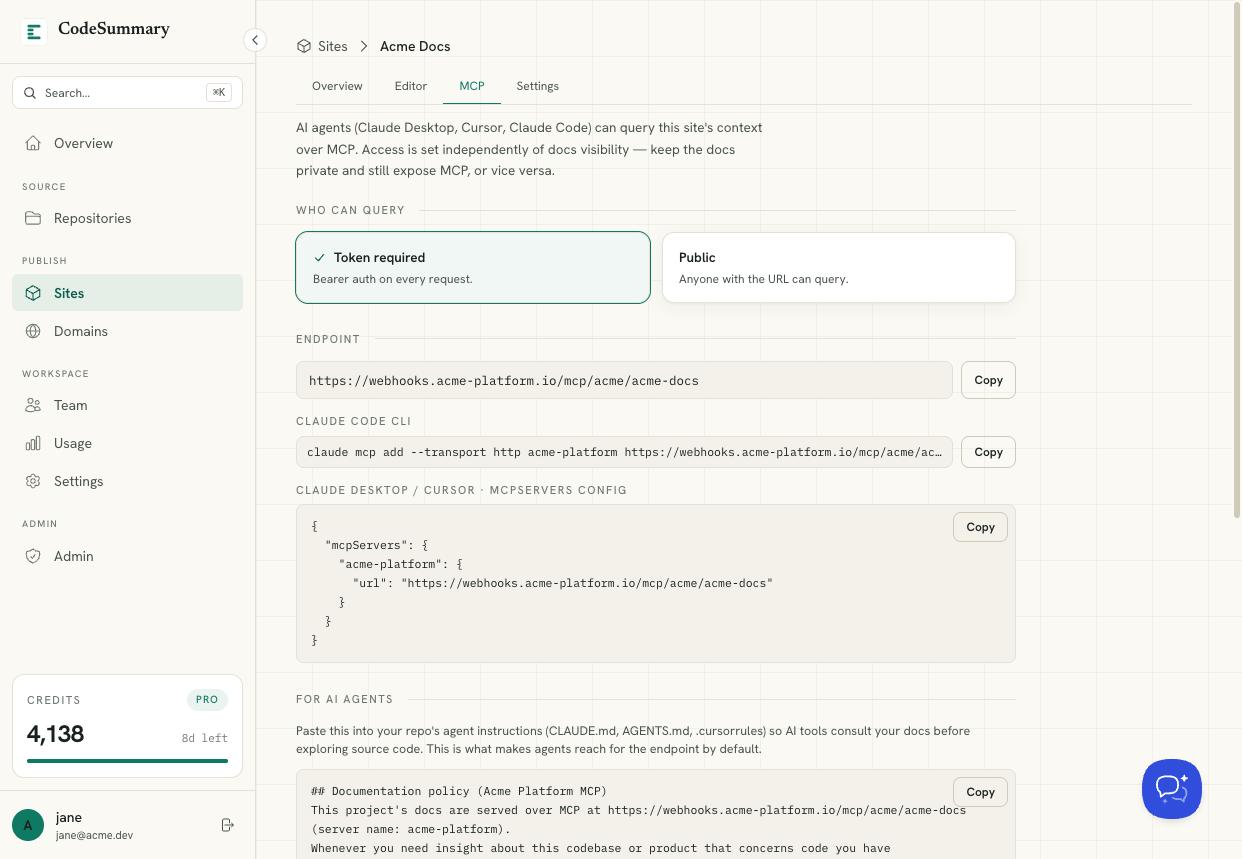
Connect a repository and Code Summary reads the actual source, generates structured documentation, and publishes it as a hosted site. As you push, it updates, so the docs track the code instead of rotting. The part that matters for 2026: the same docs are also exposed as a live MCP endpoint, so your AI coding agents read the current documentation on demand instead of guessing from a stale snapshot. One source of truth, both the human site and the agent context generated from it.
Best for: teams that want documentation produced and maintained from the codebase, published for people, and readable by agents, without hand-writing and babysitting it. Free to start; paid plans run $19 (Founder) to $899 (Scale), plus Enterprise.
Mintlify , the most polished sites, if you write the content
Mintlify is the leading AI-native documentation platform, trusted by thousands of companies, and it produces the most beautiful developer doc sites in the category, with strong AI writing assistance. The tradeoff: it is a publishing platform, not a code-to-docs generator. You bring or write the content; the AI helps you refine it. If your bottleneck is producing docs from a codebase, that work is still on you.
Best for: teams that already have docs (or will write them) and want a best-in-class place to publish them.
DeepWiki , the fastest way to understand a repo
DeepWiki generates an interactive wiki for a GitHub repo from its URL, complete with architecture and module diagrams. It is excellent for quickly orienting yourself in an unfamiliar codebase. The limit: it is primarily a read-only understanding tool, not a system for publishing and maintaining your own branded documentation as a product surface.
Best for: onboarding onto, or evaluating, a codebase you didn't write.
Swimm , best-in-class stale-doc detection
Swimm pioneered code-coupled documentation: docs linked to specific code snippets that flag or update when those snippets change. If your single biggest pain is docs drifting out of sync, no other tool detects staleness as precisely. The tradeoff: you still author the documentation; Swimm keeps it honest rather than generating it from scratch.
Best for: teams with existing docs who want them to stay tied to the code.
DocuWriter , a generated doc tree from source
DocuWriter connects to a repository and generates a book-style documentation tree from your source, including code and API docs and diagrams, and keeps it in sync as the code evolves. A solid code-to-docs generator.
Best for: teams that want a generated reference tree from their source.
GitBook and ReadMe , knowledge bases and API reference
GitBook is a broad documentation platform with visual and Git-based editing, used by a large number of organizations. ReadMe specializes in interactive API reference with an explorer and code samples. Both are publishing platforms rather than code-to-docs generators.
Best for: company knowledge bases (GitBook) and polished public API docs (ReadMe).
CodeGPT and GitHub Copilot , explanations in your editor
These are IDE assistants. They are great at explaining code inline as you work, but they do not produce a maintained documentation surface for your team or your users.
Best for: individual developers who want answers in the editor, not a docs system.
How to choose
- You want a polished site and you'll write the content , Mintlify (or GitBook for a knowledge base, ReadMe for API docs).
- You just need to understand a repo quickly , DeepWiki.
- You have docs and they keep going stale , Swimm.
- You want docs generated from your code, published, and kept current, and readable by your AI agents , Code Summary.
The 2026 reality is that the last bullet is the one most teams actually have: code is moving fast, nobody has time to hand-write docs, and AI agents now need that context too. That is the gap Code Summary is built for, documentation generated from the source, maintained automatically, and served to both your developers and their agents from one place.
Start
If your problem is producing and maintaining real documentation from a live codebase, rather than authoring a site by hand, publishing your first doc site is free, and the agent-readable MCP endpoint comes with it.