
Hiring an engineer is expensive. Waiting three months for them to understand the codebase is even more expensive.
Most companies do not have a talent problem during onboarding. They have a context problem. The new engineer is capable, but the system is undocumented, the real architecture lives in senior engineers' heads, and every task requires a scavenger hunt through code, Slack threads, stale wiki pages, and old pull requests.
That is how a smart engineer spends their first month asking basic questions instead of shipping meaningful work.
It does not have to work that way. With current, code-based documentation, a new engineer can understand the product, trace important flows, and make useful contributions in days instead of months.
The slow onboarding trap
The usual onboarding plan looks reasonable on paper:
- Give the new engineer repo access.
- Send them the setup guide.
- Pair them with a senior engineer.
- Assign a small starter ticket.
- Let them learn the system over time.
The problem is that the real system is rarely written down. The setup guide explains how to run the app, but not why the app is shaped the way it is. The senior engineer knows the architecture, but has their own work to do. The starter ticket looks small, but touches five unfamiliar modules.
So the new engineer learns by interruption:
- "Where does this route live?"
- "Why do we call this service twice?"
- "Is this table still used?"
- "Which worker handles this event?"
- "Is this pattern current or legacy?"
None of those are bad questions. They are symptoms of missing context.
What a productive first week should look like
If your documentation is current, the first week can be structured around understanding and contribution instead of archaeology.
Day 1: Understand the shape of the system
The new engineer should be able to read a high-level overview and answer:
- What repos and services exist?
- What does each one own?
- How does a user request move through the product?
- Where does data live?
- What background jobs or integrations matter?
This is the map. Without it, every file looks equally important.
Day 2: Trace the critical flows
Next, they should follow the flows that make the product work:
- Signup and authentication
- Billing or entitlement checks
- Core product workflow
- Data import or generation pipeline
- Notifications, webhooks, or integrations
- Admin and support actions
Tracing flows teaches them how the product behaves in production, not just how folders are arranged.
Day 3: Learn the local patterns
Every engineering team has conventions:
- Where business logic belongs
- How API routes are structured
- How errors are handled
- How database access is organized
- How tests are written
- How feature flags, config, or permissions are checked
If those patterns are documented, the first pull request looks like it belongs in the codebase. If they are not, code review becomes the onboarding manual.
Day 4: Make a safe change
By the fourth day, a new engineer should be able to pick up a contained ticket and understand the surrounding code before editing it.
That does not mean they know everything. It means they have enough context to avoid guessing. They can read the relevant module docs, trace the call path, see related files, and ask specific questions when something is unclear.
Specific questions are good. "Does this flow intentionally skip the entitlement check for internal users?" is a much better question than "How does this area work?"
Day 5: Ship with confidence
The goal is not to force a heroic first-week launch. The goal is to make the first real contribution feel normal:
- The engineer understands the area they touched.
- The pull request follows existing conventions.
- Review focuses on product logic, not basic orientation.
- Senior engineers are available for judgment, not repetitive explanation.
That is what "productive in days" actually means.
The documentation new engineers actually need
New engineers do not need a giant onboarding binder. They need documentation that answers the questions they hit while working.
A repo map
Start with what exists:
- Repositories
- Applications
- Services
- Shared packages
- Workers or background processes
- Public surfaces and internal tools
This helps new engineers know where to look before they open a single file.
Architecture overviews
Document how the system fits together:
- Request paths
- Data flow
- External dependencies
- Authentication and authorization boundaries
- Storage systems
- Deployment surfaces
Architecture docs should explain the system at the level a new engineer needs to make changes safely.
Module and service explanations
For each important area, explain:
- What it does
- What it owns
- What calls it
- What it calls
- What data it reads or writes
- What failure modes matter
This is where engineers stop guessing from filenames and start understanding behavior.
Development patterns
Document the way your team works in code:
- How to add a route
- How to add a database field
- How to enqueue a job
- How to publish an event
- How to write a test
- How to handle errors
These are the small details that make first pull requests either smooth or painful.
Known sharp edges
Every codebase has areas that deserve caution:
- Legacy modules
- Under-tested flows
- Critical billing or permissions checks
- Manual operational steps
- Third-party integrations with unusual behavior
- Code that is being replaced but still runs
Writing these down is not a confession of failure. It is how you keep new engineers from stepping on the same landmines.
Why stale onboarding docs make things worse
Outdated documentation is not neutral. It actively slows people down.
When a new engineer follows a stale setup guide, reads about a service that was removed, or copies a pattern the team no longer uses, they lose trust in the docs. After that, they go back to asking people everything.
This is why onboarding documentation has to stay connected to the code. A one-time doc sprint helps for a few weeks. Current documentation helps every hire.
How Code Summary helps
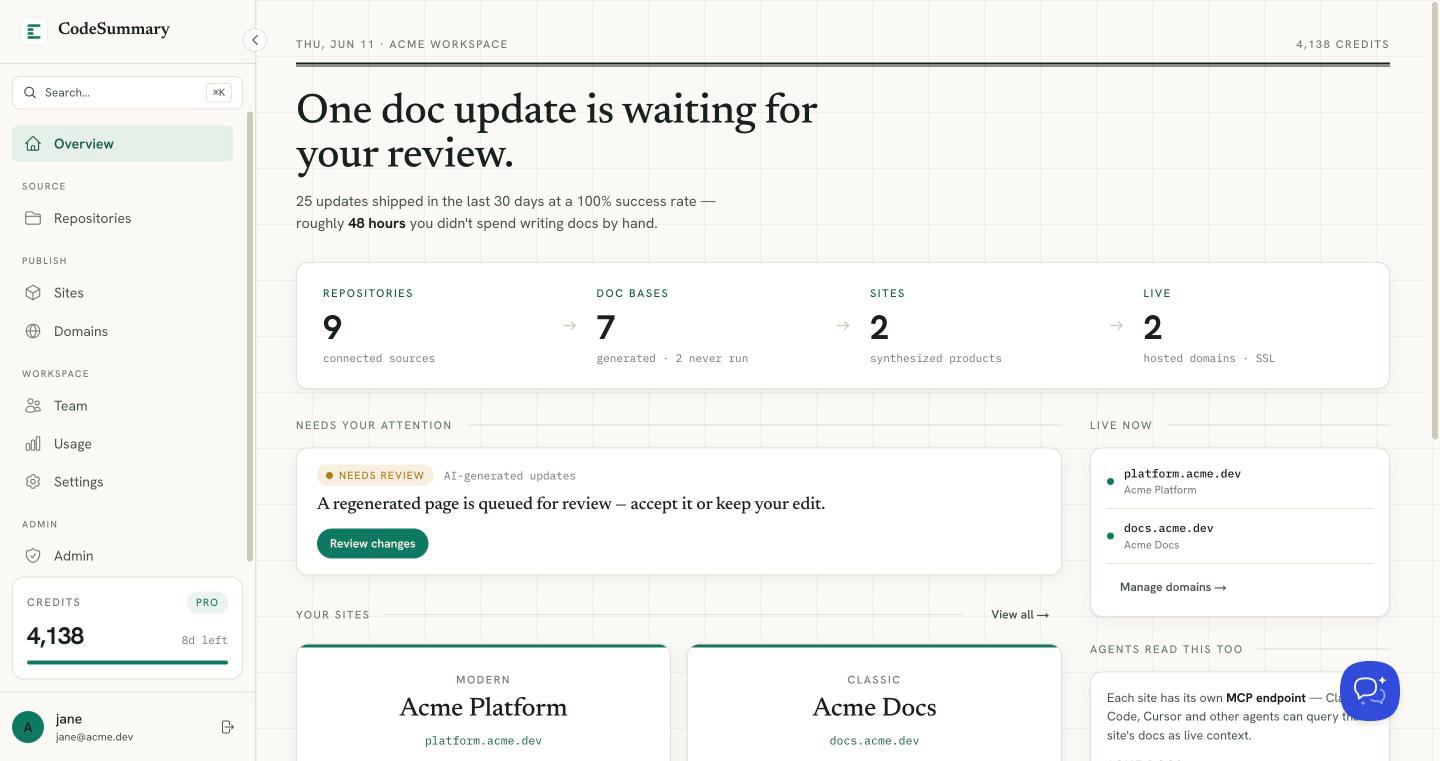
Code Summary generates documentation from your repositories, so new engineers get a current map of the actual codebase instead of a hand-written snapshot from last quarter.
Connect a repo, generate docs, review what matters, and publish them privately for your team. As the code changes, the docs can be regenerated so the onboarding material keeps up with the product.
That gives new engineers:
- A codebase overview before they start digging
- Service and module explanations
- Critical flow documentation
- Setup and operational context
- Private hosted docs they can search
- Agent-readable docs for AI coding tools
It also protects senior engineers' focus. They still mentor, review, and explain judgment calls, but they are not the only source of basic system knowledge.
The first hire is the best time to start
Documentation compounds. The first version helps the next engineer. The questions from that engineer improve the docs for the engineer after them. Over time, onboarding becomes a system instead of a ritual of repeated interruptions.
If you are hiring now, do not wait until the new engineer starts. Generate the docs before day one. Review the critical flows. Mark the sharp edges. Give them a map.
Your new engineer should spend their first month building product knowledge, not reconstructing it from scattered clues.